
Master Specific Detail & EXCEPT Questions
The most frequent question type in CAT RC. Learn systematic scanning strategies, avoid detail traps, and master EXCEPT-format reversals. Never lose easy marks again.
📚 Detail & EXCEPT Questions Flashcards
Master scanning strategies and trap recognition
Loading…
Loading…
🎯 Test Your Detail Question Skills
5 CAT-style questions with detailed trap analysis
🎯 Test Complete!
Recent studies on Mediterranean diet adherence tracked 2,500 participants across five European countries over ten years. Researchers found that individuals who closely followed Mediterranean eating patterns experienced 30% fewer cardiovascular events compared to those with low adherence. The diet emphasizes olive oil, fish, vegetables, and whole grains while limiting red meat and processed foods. Participants who maintained high adherence for at least seven years showed the most significant benefits. The study controlled for age, exercise levels, and pre-existing health conditions. Researchers noted that moderate adherence provided some protective effects, but these were less pronounced than in the high-adherence group. The findings suggest that consistent, long-term commitment to Mediterranean dietary patterns offers substantial cardiovascular protection.
According to the passage, which of the following is true about the Mediterranean diet study?
✓ Correct! Option B is the answer.
Why B is correct: The passage explicitly states the study “tracked 2,500 participants across five European countries over ten years.” Option B is a direct, accurate paraphrase keeping all key details intact: five countries, ten years (a decade).
A: Overgeneralization + extreme language. Passage says “30% fewer events,” not “eliminated entirely.” “Fewer” ≠ zero.
C: Contradicts passage. Text states benefits varied by adherence duration – “most significant” for 7+ years, “less pronounced” for moderate.
D: Scope shift. Passage says diet “limits red meat,” not “complete elimination of all meat.” Fish is explicitly included.
Cloud-based collaboration tools have transformed remote work practices since 2020. Companies report that employees using real-time document editing platforms complete projects 25% faster than those relying on email attachments. These tools allow multiple users to edit documents simultaneously while tracking all changes. However, the transition presents challenges. Many employees over 50 struggle with the learning curve, requiring additional training sessions. Security concerns also persist, as some industries handling sensitive data hesitate to adopt cloud storage. Despite these obstacles, adoption rates continue climbing. A survey of 1,000 companies found that 78% now use at least one cloud collaboration tool, up from 45% in 2019. Industry analysts predict this figure will reach 90% by 2026 as digital literacy improves and security protocols strengthen.
According to the passage, all of the following are mentioned EXCEPT:
✓ Correct! Option D is the EXCEPT answer.
Why D is correct: The passage mentions training needs (A), simultaneous editing (B), and security concerns (C). However, it never claims cloud tools have “completely replaced” email. It only compares speed between real-time editing vs email, without stating email has been replaced.
Options A, B, and C are all explicitly stated in the passage. In EXCEPT questions, you must find the ONE option that is NOT supported. Always mark each option as you check it – this prevents forgetting the reversal.
Urban tree-planting initiatives have gained momentum as cities seek to combat heat island effects. Studies in Phoenix and Los Angeles demonstrate that neighborhoods with 30% tree canopy coverage experience temperatures 5-7 degrees Fahrenheit cooler than areas with minimal tree cover. The cooling effect is most pronounced during summer afternoons. However, experts caution against viewing trees as a complete solution. Dr. Sarah Martinez, urban forestry specialist, notes that tree selection matters significantly – native species require less water and maintenance than ornamental imports. Additionally, tree planting must be accompanied by other interventions such as reflective roofing and permeable pavements to achieve substantial temperature reductions. Some low-income neighborhoods lack the infrastructure to maintain planted trees, leading to survival rates below 50% in certain districts. Successful programs combine planting with long-term community engagement and maintenance support.
According to the passage, which of the following is true about urban tree canopy coverage?
✓ Correct! Option B is the answer.
Why B is correct: The passage specifically states “Studies in Phoenix and Los Angeles demonstrate that neighborhoods with 30% tree canopy coverage experience temperatures 5-7 degrees Fahrenheit cooler.” Option B directly and accurately paraphrases this statement, preserving all key details.
A: Overgeneralization. Passage discusses two specific cities and mentions survival challenges. “All cities” and “successfully” are unsupported.
C: Opposite meaning. Passage explicitly states native species “require less water and maintenance than ornamental imports” – they are NOT identical.
D: Contradicts qualification. Passage warns against viewing trees as “complete solution” and states other interventions are needed. “Alone is sufficient” contradicts this.
Spaced repetition, a learning technique involving review of material at increasing intervals, has gained scientific validation through cognitive psychology research. The method works by strategically timing review sessions to occur just before information would typically be forgotten. Laboratory studies show that students using spaced repetition retain 80% of material after six months, compared to 20% retention for those using massed practice (cramming). However, the technique requires initial investment and discipline. Students must review material multiple times over weeks or months rather than completing all studying in one or two intensive sessions. Many learners find this approach counterintuitive, as massed practice creates an illusion of learning through short-term familiarity. Educational psychologists recommend starting spaced repetition early in a course rather than waiting until exam preparation begins. The technique proves most effective for factual information and vocabulary but shows mixed results for complex problem-solving skills.
The passage indicates which of the following about spaced repetition?
✓ Correct! Option A is the answer.
Why A is correct: The passage states students using spaced repetition retain “80% of material after six months, compared to 20% retention for massed practice.” This is a 4:1 ratio (80% is four times 20%), making option A an accurate mathematical paraphrase of the stated comparison.
B: Contradicts stated limitation. Passage says technique is “most effective for factual information and vocabulary but shows mixed results for complex problem-solving” – NOT equally well for all types.
C: Opposite meaning. Passage states “Many learners find this approach counterintuitive” and mentions cramming creates “illusion of learning” – students are drawn to cramming despite its ineffectiveness.
D: Unsupported inference. Passage never discusses what happens to exam-time review needs. This is an invented claim.
Behavioral economists have challenged the traditional assumption that consumers make rational purchasing decisions by consistently choosing products that maximize value. Research demonstrates that presentation order significantly influences choices. In one study, when consumers evaluated products sequentially, 65% chose the first high-quality option presented, even when superior options appeared later in the sequence. This “satisficing” behavior – selecting the first acceptable option rather than searching for the optimal one – contradicts rational choice theory’s predictions. The effect intensifies when consumers face time pressure or decision fatigue. Interestingly, this behavior persists even when consumers know additional options exist and explicitly state their intention to evaluate all choices before deciding. Market researchers now design product displays and website layouts to capitalize on these tendencies, placing preferred items early in browsing sequences. The practice raises ethical questions about whether manipulating presentation order constitutes unfair advantage or merely effective marketing strategy that acknowledges realistic consumer behavior.
According to the passage, each of the following is true EXCEPT:
✓ Correct! Option C is the EXCEPT answer.
Why C is correct: Options A, B, and D are all explicitly stated. However, the passage specifically says “this behavior persists even when consumers KNOW additional options exist and explicitly state their intention to evaluate all choices.” This directly contradicts C’s claim that consumers “are unaware that additional options are available.” The passage emphasizes satisficing happens despite awareness, not because of ignorance.
This is a harder EXCEPT question because it tests careful reading of qualifiers. The passage makes a point of emphasizing that awareness doesn’t prevent satisficing – consumers know but still do it. Missing this qualifier leads to selecting option C as supported when it actually contradicts the passage.

💡 How to Master Detail & EXCEPT Questions
Strategic approaches proven to boost accuracy from 60% to 90%+ in 7 days
The Four-Step Scanning Method
Detail questions reward systematic execution over clever interpretation. Execute this sequence every single time:
Step 1: Identify the Word-Hook
Find the key term, name, phrase, or concept in the question stem. This is your search anchor.
- Choose concrete nouns over abstract concepts
- Prefer proper nouns, specific terms, unique phrases
- Example: “Galapagos finches” beats “evolutionary process”
Step 2: Scan for the Hook
Don’t reread the entire passage. Scan specifically for your word-hook or its direct synonym.
- Your eyes should jump across lines looking for the target word
- Read 2-3 lines before and after where you find it
- Context matters – the sentence might say “However, critics argue…”
Step 3: Lock the Meaning
Paraphrase what those lines actually say in the simplest language possible: “Here, the author says X about Y.”
- Be specific about quantity (some vs many vs all)
- Be specific about time (past vs present vs future)
- Be specific about comparison (more than vs different from)
- This precision prevents overgeneralized options
Step 4: Match to Options with Elimination
Now check options against your locked meaning. Eliminate anything that:
- Adds information not in those lines
- Changes quantities or comparisons
- Shifts time frames
- Generalizes from specific cases
- Uses opposite language
Spending 5 extra seconds underlining quantifiers in the passage (“some,” “many,” “often,” “may”) saves 20 seconds eliminating options because traps become obvious. Most traps attack exactly these qualifiers.
Master the Six Trap Patterns
Learn these trap patterns and you’ll eliminate 60-70% of wrong answers in 10 seconds. Most students fall for the same traps repeatedly until they build conscious recognition:
- Half-True, Half-False: First part accurate, second part adds unsupported twist. Always verify the ENTIRE option.
- Overgeneralization: Passage says “some,” “many,” “often,” “may.” Option removes qualifiers: “all,” “always,” “will,” “proves.”
- Scope Shift: Passage discusses X in specific context. Option extends to all times, places, groups.
- Wrong Comparison: Passage compares A and B. Option flips comparison or changes basis.
- Opposite Meaning: Uses same words but reverses claim. “Declined” becomes “increased.”
- Out-of-Passage Knowledge: States something generally true but not in passage. Feels right based on real-world knowledge.
After each wrong detail question, classify the trap type. After 30 questions, you’ll notice you fall for specific trap types repeatedly. Hunt for those specifically in future questions. This builds pattern recognition faster than generic practice.
EXCEPT Questions: The Reversal Strategy
EXCEPT questions flip the task. Instead of finding the supported statement, you find the one that ISN’T supported. This reversal requires systematic checking:
Critical First Step: Mark the EXCEPT
Physically underline or circle “EXCEPT,” “NOT,” or “LEAST” in the question stem. You need a visual reminder that you’re looking for the wrong/unsupported option, not the right one.
Forgetting the reversal is the most common error. You’ll find a well-supported option and select it, forgetting you wanted the unsupported one.
Systematic True/False Checking
Treat each option as a claim to verify. Ask: “Can I find clear support for this in the passage?”
- If yes (you can point to lines supporting it) → mark “T” or “Supported”
- If no (you cannot find support) → mark “F” or “Suspected EXCEPT answer”
- Don’t evaluate all options simultaneously
- Check them one at a time, marking each
Don’t Over-Infer on EXCEPT
EXCEPT questions punish inference. If the passage doesn’t clearly say it, it’s not supported. Don’t fill gaps with logical reasoning.
Passage might say “Policy A reduced costs.” Option says “Policy A was cost-effective.” Not the same claim. “Reduced costs” doesn’t necessarily mean “cost-effective” (might have required huge investment).
Find 3-4 clearly supported options. The remaining one is your answer. You don’t need to prove it’s false – just that it’s not stated or supported. EXCEPT questions test literal support, not reasonable inference.
Time Management & Speed Building
Top scorers answer detail questions in 55-75 seconds and EXCEPT questions in 70-90 seconds. They’re not reading faster – they’re recognizing patterns faster:
Time Breakdown for Detail Questions (55-75 seconds)
- Identify word-hook and scan to locate: 15-20 seconds
- Read surrounding context and lock meaning: 20-25 seconds
- Evaluate and eliminate options: 15-20 seconds
- Final verification: 5-10 seconds
Time Breakdown for EXCEPT Questions (70-90 seconds)
- Mark “EXCEPT” and understand task: 10-15 seconds
- Check each option against passage: 40-50 seconds (8-10 seconds per option)
- Final verification: 10-15 seconds
- Practice the locked-meaning drill: For 20 detail questions, write one sentence stating what relevant passage lines say BEFORE looking at options
- Build a personal trap catalog: After each wrong question, classify the trap type
- For EXCEPT questions, practice marking discipline: Write “T” or “F” next to each option before selecting
- Time yourself strictly: If you exceed target times regularly, you’re overthinking – trust your locked meaning and execute
Track your elimination rate. If you can’t quickly eliminate at least 2 options in the first 15 seconds on detail questions, you’re not recognizing trap patterns. Study wrong answers systematically to build trap recognition. Good detail question execution: 15 seconds to locate and lock meaning, 10 seconds to eliminate 2-3 obvious traps, 10 seconds to choose between remaining options.
The Complete Guide: From Theory to Mastery
You’ve practiced the flashcards. You’ve tested yourself. Now understand why the strategies work—and how to adapt them to any CAT passage you’ll encounter.
Understanding RC Specific Detail Questions in CAT Reading Comprehension
RC specific detail questions test whether you can locate and accurately understand small, stated facts in the passage. They don’t ask for interpretation or inference. They ask: What does the passage actually say about X?
These are “according to the passage” questions. The answer is explicitly there, waiting to be found. Your job is locating it, reading it carefully, and matching it to the correct option without adding assumptions or distortions.
Most test-takers make detail questions harder than they need to be. They try to answer from memory instead of scanning back to verify. Or they pick options that sound right based on the passage’s general theme rather than checking specific wording. This approach fails because CAT designs wrong answers to exploit exactly these shortcuts.
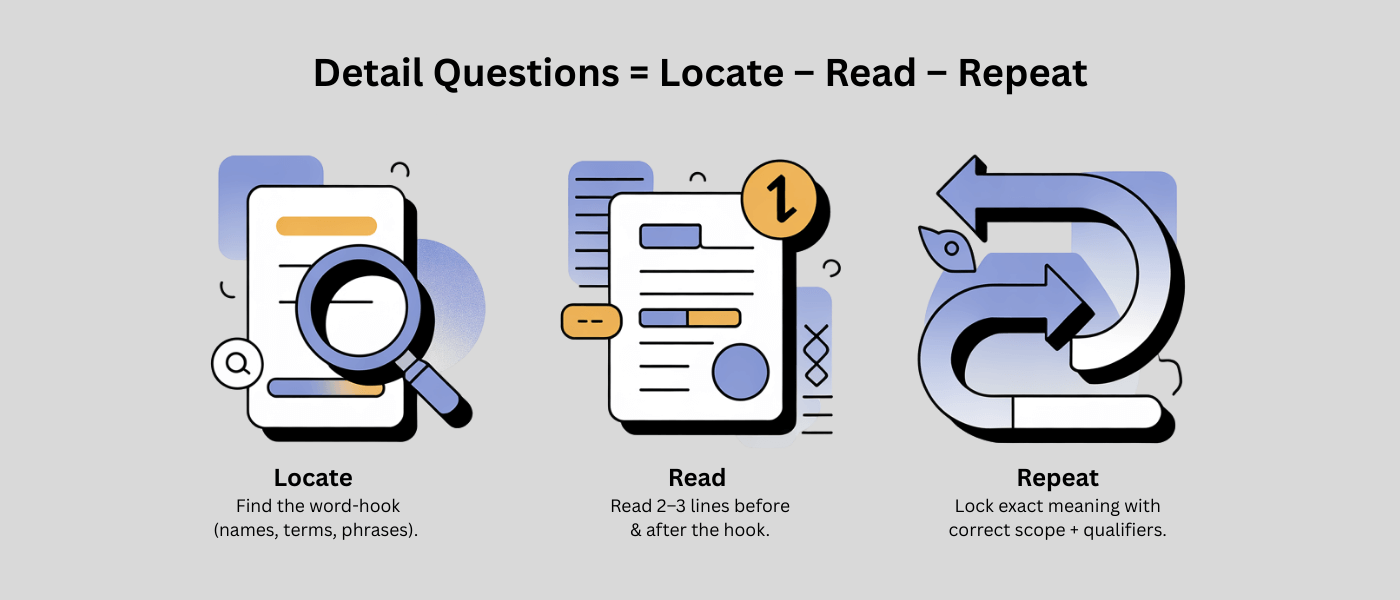
Core Principle: Detail questions = Locate → Read → Repeat. NOT Guess → Interpret → Invent. If you can’t point to specific lines supporting your answer, you’re guessing.
Pause & Reflect
Before reading further: Do you typically scan back to verify your answer on detail questions, or do you answer from memory?
If you’re answering from memory, you’re gambling. Detail questions punish this approach because CAT designs traps that exploit how memory distorts information.
Memory generalizes. Passage says “some studies suggest” — your memory stores “studies show.” Passage says “reduced by 30%” — your memory stores “significantly reduced.” These small distortions are exactly what wrong answers exploit.
Always scan back. Even if you remember the content, verify the exact wording. The 10 seconds spent scanning saves you from losing marks on trap answers.
The Four-Step Scanning Method for Detail Questions
Execute this sequence for every detail question. Skipping steps costs you accuracy.
Step 1: Identify the Word-Hook — Find the key term, name, phrase, or concept in the question stem. This is your search anchor. The question might ask “According to the passage, the author’s view on urban planning is…” Your word-hook is “urban planning.”
Choose concrete nouns over abstract concepts when possible. “Galapagos finches” is a better hook than “evolutionary process.” Proper nouns, specific terms, and unique phrases are easiest to scan for.
Step 2: Scan for the Hook — Don’t reread the entire passage. Scan specifically for your word-hook or its direct synonym. Your eyes should jump across lines looking for the target word, not processing every sentence.
Read 2-3 lines before and 2-3 lines after where you find the hook. Context matters. The sentence with your hook might say “However, critics argue…” meaning the view being expressed isn’t the author’s. You need surrounding lines to understand whose view you’re reading.
Step 3: Lock the Meaning — Paraphrase what those lines actually say in the simplest language possible. Strip away complex vocabulary and note the core claim.
Example: Passage line: “Studies in three coastal cities showed a 15% reduction in traffic accidents after implementing the new signal system.”
Locked meaning: “New signals reduced accidents by 15% in three coastal cities (not all cities, not all types of accidents, specific percentage).”
This precision prevents you from accepting overgeneralized options.
Test Your Understanding
Quick check: Why is it critical to note qualifiers like “some,” “many,” “often,” “may” when locking the meaning?
Because most trap answers attack exactly these qualifiers.
Passage says “some studies suggest” → Wrong option says “research proves.” Passage says “may reduce” → Wrong option says “eliminates.” Passage says “in many cases” → Wrong option says “always occurs.”
The distortion is subtle but fatal. If you don’t explicitly note the qualifier when locking meaning, you’ll miss that the option changed it.
Spend 5 seconds underlining quantifiers and time markers in the relevant passage section. This makes trap detection instant when you read options.
Step 4: Match to Options with Elimination — Now check options against your locked meaning. Eliminate anything that adds information, changes quantities, shifts time frames, generalizes from specific cases, or uses opposite language. The correct answer will be a close paraphrase of what you locked in, keeping all the qualifiers and scope intact.
Six Common Trap Patterns in Detail Questions
Learn these traps and you’ll eliminate 60-70% of wrong answers in 10 seconds.
Trap 1: Half-True, Half-False — The first part of the option accurately reflects the passage. The second part adds a twist or unsupported claim. Test-takers see the true part and select without checking the complete statement.
Example: Passage says “Urban farms provide fresh produce and create community spaces.” Option says “Urban farms provide fresh produce and reduce crime rates.”
First half true, second half unsupported. Always verify the entire option.
Trap 2: Overgeneralization — The passage carefully qualifies: “some studies suggest,” “in many cases,” “often occurs,” “may lead to.” The option removes qualifiers: “all studies prove,” “always occurs,” “definitely leads to.”
Trap 3: Scope Shift — The passage discusses X in a particular context – a specific time, place, or group. The option extends X to all times, all places, or all groups. Verify: same group, same time frame, same conditions. Any expansion is a trap.
Strategy in Action
You read: “Studies on smartphone use among teenagers in urban areas found increased screen time correlated with sleep disruption.” Which part must match in the correct answer?
The italicized qualifiers: “among teenagers in urban areas.”
Wrong answers will expand this: “all age groups,” “people in general,” “smartphone users.” If the option says “Studies found increased screen time disrupts sleep in all demographics,” it’s a scope shift trap.
The core finding (screen time affects sleep) might be true generally, but the passage only supports it for a specific group.
When locking meaning, explicitly note: “For which group? In what context? Under what conditions?” If the option changes any of these, eliminate it immediately.
Trap 4: Wrong Comparison — The passage compares A and B: “A is more effective than B for task C.” The option flips it: “B is less effective than A” sounds equivalent but might change emphasis. Or worse: “A is more effective than B for all tasks” – changes the basis of comparison.
Trap 5: Opposite Meaning — Uses the same words from the passage but reverses the claim. Passage says “declined,” option says “increased.” This trap works because test-takers recognize vocabulary and assume the claim matches. Always check the direction of the claim, not just the words used.
Trap 6: Out-of-Passage Knowledge — The option states something that’s generally true or logically reasonable but not actually stated in the passage. It feels right based on real-world knowledge. Ask: Is this in the passage, or am I adding it from what I know?
EXCEPT Questions: The Reversal Strategy
EXCEPT questions flip the task. Instead of finding the supported statement, you find the one that isn’t supported. This reversal requires systematic checking.
Critical First Step: Mark the EXCEPT — Physically underline or circle “EXCEPT,” “NOT,” or “LEAST” in the question stem. You need a visual reminder that you’re looking for the wrong/unsupported option, not the right one.
Forgetting the reversal is the most common error. You’ll find a well-supported option and select it, forgetting you wanted the unsupported one. The visual mark prevents this.
Systematic True/False Checking — Treat each option as a claim to verify. Ask: “Can I find clear support for this in the passage?” Mark “T” (supported) or “F” (not supported). Don’t evaluate all options simultaneously. Check them one at a time.
Reality Check
Be honest: When you see an EXCEPT question, do you systematically mark each option as T/F, or do you evaluate all five simultaneously in your head?
If you’re evaluating simultaneously, you’re making EXCEPT questions 3x harder than they need to be.
Your working memory can only reliably hold 3-4 items. With 5 options to verify, you’ll inevitably recheck options you already verified, forget which ones you’ve confirmed, or mix up which evidence supports which claim.
Sequential checking with physical marks solves this. Mark each option as you verify it. Once you have 3-4 clear “T” marks, you’re done — the remaining option is your answer.
Force yourself to write “T” or “F” next to each option for the next 10 EXCEPT questions you attempt. The discipline becomes automatic, and your accuracy will jump 15-20%.
Don’t Over-Infer on EXCEPT — EXCEPT questions punish inference. If the passage doesn’t clearly say it, it’s not supported. Don’t fill gaps with logical reasoning. Passage might say “Policy A reduced costs.” Option says “Policy A was cost-effective.” Not the same claim. “Reduced costs” doesn’t necessarily mean “cost-effective” (might have required huge investment).
Practical Hacks for Speed and Accuracy
Hack 1: Don’t Read Options First — For pure detail questions, identify your word-hook and locate the relevant passage section before looking at options. This anchors you in the actual text rather than getting influenced by wrong answer wording.
Hack 2: Copy Mental Structure — When you find relevant lines, note their structure: Subject → Action → Object → Qualifier. Check each element in the option. Most traps change one element.
Hack 3: Underline Quantifiers and Time Markers — In the relevant passage section, physically underline: some, many, most, all, rarely, often, usually, always, never, was, is, will be, may, can, must. These words determine scope and certainty. Most traps attack exactly these qualifiers.
Final Self-Assessment
After reading this entire guide, can you now execute the four-step scanning method from memory?
If you can recite it clearly, you’ve internalized the method. If you’re still fuzzy, that’s your signal to review.
Here’s what you should be able to say:
“Step 1: Identify word-hook. Step 2: Scan for hook, read 2-3 lines around it. Step 3: Lock the meaning by paraphrasing what it says. Step 4: Match to options, eliminating distortions.”
If you can execute this sequence automatically, your detail question accuracy will jump from 60-70% to 85-90%.
If you can’t explain the method clearly, review the flashcards and re-read the “Four-Step Method” section. Understanding this framework is foundational for detail question mastery.
Ready to test your understanding? The 25 flashcards above cover every nuance of detail and EXCEPT questions, and the practice exercise gives you real CAT-style questions to apply these strategies.

❓ Frequently Asked Questions
Common questions about RC detail & EXCEPT questions answered
Detail questions are the most common question type in CAT VARC, typically accounting for 8-12 questions out of 24 RC questions. This includes both standard “according to the passage” questions and EXCEPT-format questions.
These questions appear on virtually every passage because they test fundamental reading comprehension – can you locate and accurately understand stated information? While they’re frequent, they’re not necessarily easy because CAT designs sophisticated traps that exploit how people misread or remember text.
EXCEPT questions specifically appear 2-4 times per CAT VARC section. They’re less common than standard detail questions but require more systematic checking because you must verify all options, not just find one correct answer.
Execute the four-step scanning method every time:
- Step 1: Identify word-hook (key term from question)
- Step 2: Scan for hook (find it in passage, read 2-3 lines before and after)
- Step 3: Lock the meaning (paraphrase what those lines actually say)
- Step 4: Match to options (eliminate distortions)
Never answer detail questions from memory. Always scan back to verify. Memory is unreliable and CAT exploits this by including options that sound right based on the passage’s general theme but contradict specific wording.
• Identify and scan: 15-20 seconds
• Lock meaning: 20-25 seconds
• Eliminate options: 15-20 seconds
• Verify: 5-10 seconds
Total: 55-75 seconds per detail question
The most critical step is locking the meaning before looking at options. Write or mentally articulate: “Here, the passage says X about Y.” This anchors you in the actual text.
First, verify you’re using the right word-hook. Sometimes the question asks about a concept using different vocabulary than the passage uses. Look for synonyms or related terms.
If you still can’t locate it, the information might be stated indirectly or spread across multiple sentences. Read the question stem carefully to understand exactly what’s being asked. Sometimes you’re looking for X when the question actually asks about Y’s relationship to X.
For EXCEPT questions specifically, inability to find information is actually useful. If you genuinely cannot locate support for an option after reasonable searching, it’s likely the EXCEPT answer. The correct approach is: verify support for 3-4 options clearly, and the one you can’t support is your answer.
Don’t spend more than 90 seconds searching for information. If you can’t locate it in that time, make your best guess using elimination and move on.
EXCEPT questions require 70-90 seconds, slightly longer than standard detail questions. You’re checking all five options systematically rather than just finding one correct answer.
The time breaks down: 10-15 seconds to mark “EXCEPT” and understand what you’re looking for. 40-50 seconds to check each option against the passage (8-10 seconds per option). 10-15 seconds for final verification.
Don’t try to evaluate all options simultaneously. Check them sequentially, one at a time. This systematic approach is faster and more accurate than trying to hold all five claims in working memory while jumping around the passage.
If you hit 90 seconds without a clear answer, use this tiebreaker: pick the option that would require the most inference or logical leap to support. EXCEPT questions test stated information, so the answer is usually the claim that’s reasonable but not actually stated.
They test different skills. Detail questions test precise reading and location skills. Inference questions test logical reasoning and scope control. Neither is objectively easier.
Many test-takers find detail questions more straightforward because the answer is explicitly in the passage – you’re not required to extend reasoning or make logical leaps. But detail questions have higher trap density. CAT packs more distortions into detail question options than inference question options.
Detail questions often have lower time pressure per question. You can execute the scanning method efficiently in 60-70 seconds. But this assumes you don’t waste time trying to answer from memory or falling for sophisticated traps.
“According to the passage” questions ask what is explicitly stated. The answer is there in the text, waiting to be found and matched. You’re testing reading accuracy, not reasoning ability.
Inference questions ask what logically follows from what’s stated. The answer requires you to extend the passage’s reasoning by one step. You’re combining information or drawing conclusions the passage implies but doesn’t directly state.
Passage: “Sales increased 20% after the marketing campaign launched.”
According to passage question: “The passage states that sales increased by what percentage?”
Answer: 20% (stated directly)
Inference question: “The passage suggests which of the following about the marketing campaign?”
Answer: It likely contributed to sales growth (logical inference, not stated explicitly)
The distinction matters for elimination strategy. For “according to passage” questions, eliminate anything not explicitly stated, even if it’s logically reasonable. For inference questions, eliminate only things that contradict or go too far beyond what’s stated.
When a question stem says “according to,” “states that,” “mentions,” or “indicates,” treat it as a detail question. Use the scanning method and match stated information. When it says “suggests,” “implies,” “can be inferred,” or “the author would agree,” treat it as inference.
Build trap awareness through systematic review. After each wrong detail question, classify the trap type: overgeneralization, scope shift, wrong comparison, opposite meaning, half-true/half-false, out-of-passage knowledge. Track which traps catch you most often.
Practice the locked-meaning drill. For 20 detail questions, write one sentence stating what the relevant passage lines say BEFORE looking at options. Then check which option matches without adding or changing anything. This trains you to anchor in text rather than working from memory or assumption.
1. Take 10 EXCEPT questions
2. For each, physically write “T” or “F” next to each option before selecting
3. Check your marking against the explanation
4. Identify errors: Did you miss that something wasn’t stated? Did you over-infer support?
5. Repeat with 10 more questions – accuracy should improve 15-20%
For EXCEPT questions specifically, practice the discipline of marking each option. Don’t let yourself select an answer until you’ve checked all five options and marked at least three as clearly supported. This prevents the most common error: forgetting the reversal and picking a well-supported option.
Underline quantifiers and time markers during reading. Every time you see “some,” “many,” “often,” “may,” “was,” “will be,” underline it. These words determine scope and certainty. Most traps attack exactly these qualifiers. Building the habit of noticing them dramatically improves detail question accuracy.
Time yourself strictly. Detail questions should take 55-75 seconds. EXCEPT questions should take 70-90 seconds. If you consistently exceed these times, you’re overthinking. Trust your locked meaning, execute your elimination, make your choice, move forward.

Connect with Prashant
Founder, WordPandit & EDGE | CAT VARC Expert
With 18+ years of teaching experience and thousands of successful CAT aspirants, I’m here to help you master VARC. Whether you’re stuck on RC passages, vocabulary building, or exam strategy—let’s connect and solve it together.
Stuck on RC or VARC? Let’s Solve It Together! 💡
Don’t let doubts slow you down. Whether it’s a tricky RC passage, vocabulary confusion, or exam strategy—I’m here to help. Choose your preferred way to connect and let’s tackle your challenges head-on.
🌟 Explore The Learning Inc. Network
8 specialized platforms. 1 mission: Your success in competitive exams.
Trusted by 50,000+ learners across India
Learn.WordPandit
Learn With Prashant Sir
Mentor-led courses for CAT, GMAT, GRE, GD/PI/WAT. Structured learning with expert guidance.
WordPandit
Master Words. Master Exams.
10,000+ words with roots methodology. Your vocabulary foundation for competitive exams.

Preplite
Smart Learning. Smaller Budgets.
Affordable self-prep micro-courses. Pay only for what you need. Learn at your pace.

Readlite
Read Smart. Comprehend Better.
Daily curated articles across 60+ subjects. Build reading comprehension for RC mastery.

Easy Hinglish
English Seekhna Ab Hua Aasan!
Learn English the Indian way. Vocabulary explained in Hindi and English for better retention.

GD PI WAT
Ace Your MBA Interviews.
1,000+ GD topics, PI questions, and WAT guidance. Complete MBA admission prep.

GK365
Stay Informed. Stay Ahead.
Daily GK updates and current affairs. Never miss what matters for competitive exams.

Ask English Pro
Your Personal English Mentor.
Get expert answers to all your English questions with detailed video explanations.